
Jiakang Composite Piezoelectric Ceramics
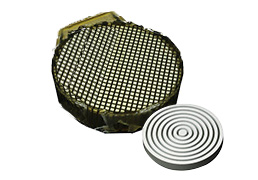 Because the acoustic impedance of the piezoelectric ceramic differs significantly from that of air, water, or organisms, the acoustic wave is difficult to incident. To address this issue, a variety of resins are mixed with piezoelectric ceramic. After the composite, the piezoceramic acoustic impedance is low, with good incident characteristics, and the ceramic volume ratio may be modified to control piezoelectric capabilities.
Main Parameters
| Part Number | HTCT |
| External Diameter | φ6~φ70mm |
| Length | 10 ∼ 80mm |
| Width | 10 ∼ 30mm |
| Thickness | 1 ∼ 15mm |
| Electrode Material | silver/copper/gold |
| Recommended Material | P-679, P-672, P-666 |
Main Materials
| Electrical Data | Symbol | Main Materials | ||||||||||||||
| P-659 | P-660 | P-663 | P-664 | P-666 | P-667 | P-668 | P-669 | P-672 | P-673 | P-676 | P-678 | P-679 | P-690 | |||
| Piezo-electric coupling coefficient | kp | 0.58 | 0.70 | 0.67 | 0.67 | 0.78 | 0.10 | 0.68 | 0.62 | 0.70 | 0.68 | 0.7 | 0.72 | 0.65 | 0.74 | |
| k31 | 0.32 | 0.39 | 0.38 | 0.37 | 0.42 | 0.39 | 0.35 | 0.41 | 0.39 | 0.45 | 0.42 | 0.38 | 0.40 | |||
| k33 | 0.60 | 0.73 | 0.70 | 0.70 | 0.78 | 0.70 | 0.68 | 0.72 | 0.70 | 0.80 | 0.72 | 0.70 | 0.75 | |||
| kt | 0.42 | 0.46 | 0.45 | 0.45 | 0.50 | 0.45 | 0.46 | 0.44 | 0.46 | 0.46 | 0.50 | 0.47 | 0.46 | 0.48 | ||
| Relative dielectric constant | εT33 / ε0 | 1100 | 3200 | 2200 | 2800 | 4500 | 180 | 2300 | 1400 | 3400 | 2200 | 6000 | 2750 | 1600 | 3800 | |
| Piezo-electric charge constant |
d33×10-12C/N |
280 | 700 | 400 | 480 | 780 | 70 | 430 | 250 | 600 | 430 | 850 | 540 | 320 | 710 | |
|
d31×10-12C/N |
-120 | -350 | -200 | -350 | -230 | -130 | -280 | -230 | -420 | -260 | -150 | -360 | ||||
| Mechanical quality factor | Qm | 100 | 60 | 80 | 500 | 60 | 2500 | 90 | 1000 | 80 | 90 | 60 | 80 | 1000 | 70 | |
| Frequency constant |
fr·d kHz·cm |
230 | 190 | 200 | 220 | 180 | 200 | 230 | 190 | 200 | 180 | 190 | 230 | 190 | ||
|
fr·t kHz·cm |
210 | 200 | 200 | 225 | 200 | 225 | 200 | 200 | ||||||||
| Temp charac-teristics |
| TKfr | (-20℃~80℃) |
100 | 260 | 300 | 120 | 400 | 30 | 150 | 100 | 300 | 100 | 400 | 200 | 100 | 260 | |
|
| TKCT | (-20℃~80℃) |
1500 | 4500 | 5000 | 2500 | 6000 | 1800 | 1500 | 4000 | 2000 | 6000 | 3000 | 1500 | 4000 | |||
| Curie Temp. |
Tc
|
320 | 220 | 220 | 230 | 180 | 450 | 355 | 340 | 230 | 325 | 140 | 280 | 330 | 210 | |
| Dielectric loss |
tgδ(%)
|
1.20 | 1.80 | 2.00 | 0.50 | 2.60 | 0.70 | 2.00 | 0.30 | 2.30 | 2.00 | 2.60 | 1.50 | 0.40 | 1.80 | |
| Dielectric loss | tgδ(400V/mm,%) | 1.00 | 1.00 | |||||||||||||